
Utility, gym and finished basements
Basement Floor Epoxy in Bloomington, IN
A bright, sealed basement floor, planned around the moisture that comes with a wet Indiana spring.
- Free on-site estimate with a slab moisture test
- Itemized written quote you approve before we start
- Floors ground with diamond tooling, never just acid-washed
A Basement Floor Starts With a Moisture Test
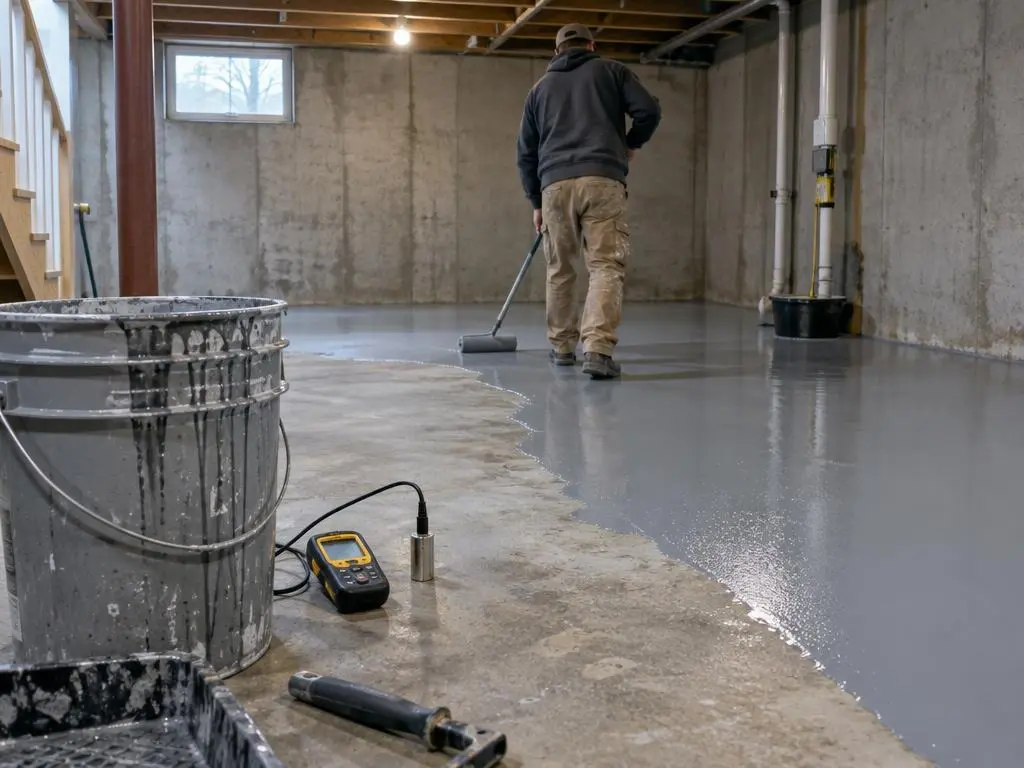
Basement floor epoxy changes a dusty grey slab into a floor you can mop, roll a chair across or put a treadmill on. In Bloomington, the planning starts with water. Monroe County's wettest month is May, with about 5.1 inches of rain on average according to Wikipedia, and basement slabs sit in that wet ground. Water vapor moving up through the concrete is the main reason basement coatings blister and let go. We test before we recommend anything.
Signs to look for first
- White powdery deposits on the slab or the bottom of the walls
- Dark patches that come and go with the weather
- Old floor paint that is bubbling or flaking
- A musty smell, or rust on metal shelving legs
- Water at the floor-wall joint after heavy rain
- A sump pump that runs often in spring
How we test
A simple plastic-sheet test, taped to the slab for a day or two, shows whether moisture is condensing underneath. Where a floor is borderline, we use more precise readings. Low to moderate readings are handled with a primer made for damp concrete. If water is actually coming in through a crack, the joint or the sump, that has to be repaired first. We will tell you that before we take a deposit.
Limestone ground and basement cracks
Bloomington sits in limestone karst, with sinkholes, springs and underground drainage. Basement slabs in this area can show settlement cracks along with ordinary shrinkage cracks. We mark each crack and check whether it is stable. Stable cracks are opened, filled and coated over. Cracks with an offset or that have grown need a closer look, and a coating should wait until the cause is known.
Radon comes first
The American Lung Association notes that every Indiana county is in EPA radon Zone 1 or Zone 2, which means medium to high potential for elevated levels. Radon enters through cracks and gaps in the floor and foundation. Sealing and coating the slab is not a radon mitigation system, and we do not sell it as one. Test first. If you need a mitigation system, it is easier to install before the floor is finished, and we coat around the pipe and sump lid.
Finishes for basements
- Solid color: a clean, light floor for laundry and storage areas. Light colors help in basements with small windows.
- Flake: hides dust and adds a little texture, good for gyms and kids' playrooms.
- Metallic epoxy: a poured finish with swirls and depth for media rooms, home bars and studio spaces.
We coat around floor drains, leave cleanouts accessible and can stop the coating at a clean line where carpet or other flooring will meet it.
Air and humidity on install day
Basements have less airflow than garages. We plan ventilation before we open any product and choose low-odor materials where it makes sense. Running a dehumidifier for a few days before install helps the coating and the room. A slab that sweats on a humid summer day should not be coated until it is dry.
What This Covers
A basement coating covers the slab and the details around drains, walls and stairs.
Moisture testing
Sheet tests and readings to see what is coming up through the slab.
Old paint and adhesive removal
Floor paint, tile mastic and sealers ground off down to sound concrete.
Crack and drain detailing
Stable cracks filled, drains and sump lids worked around, cleanouts left open.
Primer and finish
Damp-tolerant primer where needed, then solid, flake or metallic finish coats.
Typical Basement Floor Epoxy Costs
| Item | Published range |
|---|---|
| Installed epoxy, per sq ft | $4 to $10 |
| Basement floor (300 to 2,000 sq ft) | $1,200 to $20,000 |
| Metallic epoxy finish, per sq ft | $5 to $12 |
| Moisture and hardness testing | $50 to $300 |
| Patching chips and small cracks | $25 to $250 |
| Concrete resurfacing for badly worn slabs | $3 to $7 per sq ft |
National ranges from HomeGuide (epoxy, basement, resurfacing and testing) and This Old House (metallic finish and patching). Moisture, old coverings and repairs move the total. Your written estimate is the price.
How It Works
1. Inspect and test
We look for moisture signs, test the slab, and note cracks, drains and old coverings.
2. Recommend a system
Primer and finish chosen for your slab and written into the quote.
3. Grind and repair
Dust-controlled grinding, then crack filling and drain detailing.
4. Coat and ventilate
Primer and finish coats with airflow planned for the room and stairwell.
Basement Floor Epoxy Questions
Can you epoxy a basement floor that gets damp?
Often yes, if the dampness is vapor and not liquid water. We test the slab and use a primer made for damp concrete when readings call for it. If water is coming in through cracks or the floor-wall joint, that has to be fixed first.
Does epoxy stop radon?
No. A coating seals the surface but is not a radon mitigation system. Test before you finish the basement, and install a mitigation system first if you need one.
How long does a basement epoxy floor take?
Most basements take two to three days, including prep and coats. HomeGuide says to stay off a new epoxy floor for 16 to 24 hours, and furniture can usually go back after a few days.
Will the basement smell during the install?
Some products have an odor while they cure. We plan ventilation before we start, use low-odor materials where possible and tell you how long it will last with the product we choose.
Basement Floor Epoxy Service Areas
- Epoxy Flooring in Bloomington, IN
- Epoxy Flooring in Ellettsville, IN
- Epoxy Flooring in Smithville-Sanders, IN
- Epoxy Flooring in Harrodsburg, IN
- Epoxy Flooring in Stinesville, IN
- Epoxy Flooring in Unionville, IN
- Epoxy Flooring in Bedford, IN
- Epoxy Flooring in Oolitic, IN
- Epoxy Flooring in Mitchell, IN
- Epoxy Flooring in Heltonville, IN
- Epoxy Flooring in Spencer, IN
- Epoxy Flooring in Gosport, IN
- Epoxy Flooring in Martinsville, IN
- Epoxy Flooring in Paragon, IN
- Epoxy Flooring in Morgantown, IN
- Epoxy Flooring in Nashville, IN
- Epoxy Flooring in Helmsburg, IN
- Epoxy Flooring in Bloomfield, IN
- Epoxy Flooring in Worthington, IN
- Epoxy Flooring in Linton, IN
- Epoxy Flooring in Columbus, IN
Get a Basement Floor Epoxy Estimate
Free on-site estimates for basement floors, with a moisture check included.